

Scavenger hunt clues around the house: 90 riddles for 30 hiding spots
90 riddles for 30 hiding spots in an ordinary home. Pick the spots and the player’s age — the builder makes a printable clue trail.
- 90 clues
- 30 hiding spots
- free

The library
Clues by hiding spot: from the fridge to the balcony
Three clues per spot. Filter by room and age, search by word, copy the text or add a clue to your hunt. The spot names are visible only here: on the print sheet they are replaced by the organizer’s answer key.
90 of 90
Kitchen
It is big and white, it is always winter inside, and magnets live on its door. Open it — your clue is waiting on a shelf!
I have a door but no room, a light but no window, and shelves with no books. Inside me it is winter all year. Open me up and read what you find.
The most visited spot in this home after midnight: open, stare, close, repeat in five minutes. Go back one more time — this time with a purpose.
Even colder than the fridge! Ice cream and frozen peas sleep in there. Open the frostiest drawer.
It is minus eighteen in July, everything is hard as a rock, and the ice cream feels right at home. Pay it a quick visit — before anything melts.
Someone put the evidence on ice. Literally. Look where the frozen pizza calmly waits out the week and the ice cubes dream of Friday.
It has a little window, and inside a plate spins while the soup gets hot. Open the door and peek inside.
I have a window but I am not a house. I have a plate but I never eat. I hum for a minute and dinner is done. Open my door — just do not press start.
The only place in this home where time lasts exactly as long as you typed. Check where yesterday’s pizza gets its second chance.
Cookies and pies are baked in there. It has a glass door and a rack inside. Look inside — but do not switch anything on!
I am the hot heart of the kitchen, but right now I am cold. Pies are born in me and chicken turns golden. Open my door before someone slides in a tray.
On holidays this is where the magic happens; on weekdays it stores baking trays. Check what is lying between them. No recipe required.
It whistles or clicks when the water is hot. Look next to it and underneath it.
I grumble when I get angry and go quiet the moment I boil. No tea happens without me. Peek under my lid — check that I have cooled down first.
The hardest-working employee in this kitchen: switched on ten times a day, never once thanked. Look under its lid.
Forks, spoons and knives sleep together in one drawer, each in its own little bed. Find that drawer and say hello.
We have teeth but never bite, handles but never write. We all live in a narrow house that slides out. Come and look under us.
The only place in the home where everyone lies in their own slot and nobody argues. Slide it open and check under the spoons.
That is where the bread lives so it does not go dry. Open the lid and look inside.
I am a little house with a lid, and inside me live a loaf, some rolls and a lot of crumbs. Open my house — the clue is under the loaf.
This clue would have gone stale anywhere else. Open the thing that protects the loaf from yesterday. Crumbs do not count.
Soup and pasta are cooked in it. Find the biggest pot and look under the lid.
I have two ears but cannot hear, a lid but I am not a box. Soup and stew are made in me. Look under my lid.
Find the biggest pot with two handles — the one that only comes out when guests are coming. Look under the lid: tonight it is not soup.
Bathroom
It has a round window, and clothes go round and round inside. Open the door and look in the drum.
I am a porthole on a ship that never leaves the bathroom. Socks go into me and are never seen again. Look inside my drum.
This is where socks vanish without a trace and coins and receipts turn up out of nowhere. Check the drum: today there is something better than a receipt.
This is where you splash and make bubbles. Look inside — there is no water right now, but there is a clue.
A white boat that never sails. Sleepy people climb in every morning and awake people climb out. Look inside — it is empty right now.
The only place where you get twenty whole minutes alone with your thoughts. Check the bottom and the corner behind the curtain.
You see yourself in it when you brush your teeth. Look behind it or on the shelf underneath.
I copy every move you make, but I never go first. I live in the bathroom. Look behind me or under me.
Every morning you negotiate here with someone who always agrees with you. Check the frame and the shelf below.
It hangs on a hook and dries you after the bath. Look underneath it and inside its folds.
I am soft, I hang on a hook, and I am the first to know you washed your face. Unfold me — something is rustling inside.
Check the thing hanging in the bathroom that knows more about your mornings than your alarm clock does. Unfold it.
Bedroom
Where do you see your dreams? Look under the soft thing at the head of your bed.
The tooth fairy has been here before, and now a detective is coming. Look where a lost baby tooth goes.
The clue is hidden where you spend a third of your life and never once look. Lift it.
Look deeper than under the pillow: under the thing you sleep on. Lift up the corner.
The princess and the pea would have found this in a second. Check under the thing you sleep on — at the edge, by the wall.
A classic: people hid their savings here long before banks existed. Lift the edge and see what is stored there today.
Your T-shirts and dresses hang in there on hangers. Open the door and look on the bottom shelf.
Open the door that has no room behind it — only sleeves and hangers. The clue is where the things you have not worn in ages are lying.
Check the pockets of the outfit you keep for “special occasions” and have not worn since last winter.
A little cupboard right next to the bed, with a drawer. Open the drawer.
I stand next to the bed with a lamp on my head and all sorts of things inside me. Pull out my drawer.
The most honest piece of furniture in the house: it holds what you actually read before bed. Open the drawer.
Living room
Big and soft, the whole family sits on it to watch cartoons. Look under its cushions.
I am soft but I am not a pillow, long but I am not a bed. People watch movies on me and lose remotes in me. Look under my cushions.
Where coins, remotes and Saturday plans go missing. Lift the cushions and search with intent.
You use it to turn on cartoons. Find it and turn it over.
I have lots of buttons and I am always getting lost. Find me and flip me over — the clue is taped underneath.
The most-wanted object in this home. Find it and look under it: tonight the remote is the evidence.
That is where your picture books stand. Find the thickest one and look behind it.
Dragons, pirates and wizards all live here, and every one of them is silent. Look behind the thickest book.
Check behind the book you keep promising to read. Yes, that one.
Visit the plant that drinks water from its pot. Look under the pot.
I am alive but I never walk, I drink water but never from a cup. Look under my pot — and do not spill me.
The only resident who never complains when nobody waters it for a week. Look under its pot.
You can see the street from there, and the plants stand on it. Look on the windowsill, under a plant.
I stand between the room and the street and I see everything. Check my edge and whatever is standing on me.
The best lookout post in the home. Check behind the curtain and under whatever is standing on the sill.
It shines in the evening when it gets dark. Look under its foot and inside the shade.
I switch on when it gets dark and I stand on one leg. Look under my shade.
The one who lights up your evenings and has never asked for a day off. Check the shade and the base.
In winter it gets hot. Look behind it and under it.
I have lots of ribs but I am not a skeleton. In winter I warm myself and everyone else. Look between my ribs.
Check the thing that beats a blanket in January and just takes up space under the window in July. Between the sections.
That is where the laundry dries and the bike lives. Open the balcony door and look on the floor.
I am a room, but not quite: a wall on one side and the street on the other. Come and visit — the clue is under whatever stands on my floor.
The storage unit for things that “might come in handy”. Go out there and check under the most useless one.
Hallway
Where your jacket hangs. Check its pockets!
I wait for you by the door and I always know the weather. Check my pockets — both of them.
Check the pockets of your coat. Where old receipts and one lonely glove usually live, today there is something more interesting.
You wear them to go outside. Look inside the right shoe.
We have tongues but never talk, laces but we are not a present. Look inside the right one.
Search the thing that walks the streets every day and never gets past the hallway. The right one.
People step on it when they come home. Lift up its corner.
People wipe their feet on me and I never mind. Lift me up — I am not heavy.
The most obvious place for a spare key — which is exactly why nobody would think to look for evidence here. Lift it.
You carry your books and toys in it. Open the biggest pocket.
I ride on your back and I know all your homework. Open my smallest pocket.
Check the bag you carry on your back or over your shoulder. The inner pocket you always forget to zip.
It hums and eats up crumbs. Look next to it and inside its tube.
I am loud, I swallow everything, but I did not eat the clue. Find where I am parked and look in my tube.
The only thing in this home that eats crumbs off the floor and never complains. Find it: the clue is in the tube or the bag compartment.
Kids’ room
That is where your cars and dolls live. Look right at the bottom.
Teddy, the building blocks and the dinosaur know the secret, but they are not telling. Look at the very bottom of their house.
If there is a box of board games in this home, check the bottom of it. Under the game everyone keeps meaning to play.
Missing a spot? Further down there is a one-minute formula for writing a clue about the aquarium, the piano or the dog bed.
In short. A clue hunt is a chain: the player gets the first clue, works out the hiding spot, finds the next clue there, and so on until the gift. Below are 90 ready-made clues, short riddles about ordinary household objects, for 30 spots you will find in any home. Tap “Add to hunt” in the order the player should move through the rooms, and the builder at the bottom lays out the trail, tells you where each clue goes and opens a print sheet. Or download the whole library as a PDF and cut out what you need.
All 90 clues in one PDF
The library, room by room. The clues themselves never name the hiding spot — only the organizer gets that, as an answer key on the last page. A4 and Letter friendly, cut along the dashed lines.
What you get
Each clue points to one specific place, so the player follows a trail from spot to spot. Little kids get an almost direct hint, tweens get a riddle with a twist, adults get a bit of dry humour.
Hunt builder
Build your clue trail
Clues line up in the order you added them. Hand the first one over in person; every next clue waits at the spot the previous one points to. The gift goes in the last spot. Add a name and it goes into the opening note.
Your hunt is empty. Tap “Add to hunt” on the clues above, in the order the player will follow. The last spot is where the gift waits.
The print sheet opens in a new tab: clues without spot names, and the organizer’s key on the last page. Save it as a PDF or print it.
How to build a trail that does not fall apart
Five to seven clues is the sweet spot
Four or five for little kids, six or seven for tweens, seven to nine for adults. Longer and people get tired and start peeking; shorter and nobody gets into it.
Go around the home in a loop
Kitchen → bathroom → bedroom → living room → hallway. That way the player is not running through the same room ten times and does not stumble on a clue too early.
One spot, one clue
Never put two clues in one place and do not use neighbouring spots back to back: fridge then freezer is asking for both to be found at once.
Hide in reverse order
Gift into the last spot first, then the clue that points to it into the spot before, and so on until the first clue, which stays in your hand. That way no clue is ever “ahead” of the player.
Check that the spot is free and safe
Oven and kettle cooled down, pot empty, microwave not going to start by accident. For little kids: nothing above head height and no knife drawers — that is what the bread box and the toy box are for.
Agree on hints before you start
“Warmer / colder” or one hint per clue. A dead end longer than two minutes kills the excitement, especially for kids.
How to write a clue for any hiding spot
All 90 clues above follow one formula — and it works for the aquarium, the dog bed and the garden shed just as well.
Feature + misdirection + action. Take one obvious feature of the object (the fridge hums and lights up inside), describe it as if it were something else (a light that only comes on when you open the door), and end with an action (open, look, lift). The action matters most: without it a child guesses the word but does not know what to do next.
Three difficulty levels for the same spot. Little kids: the plain feature — “it is always cold in there and the yoghurts live inside”. Tweens: the same feature as an “I have… but…” riddle — “I have a door but no room, a light but no window”. Adults: a habit tied to the object — “where you go after midnight to look and close the door again”. One spot, three texts, all leading to the same place.
The one-place test. Read your clue and count how many places in the home it fits. If “under something soft” could be the sofa, the bed or the armchair, add a feature that leaves only one: “where we watch movies”. A good clue leads to one place; a bad one leads to a room.
- Aquarium: “The only tenants who never go outside and never say a word. Look under their house — not in the water.”
- Piano: “It has eighty-eight teeth and never bites. Lift the lid.”
- Dog bed: “Check the bed of the one who sleeps more than anyone in this family and never makes it.”
Ready-made hunts and more

Detective hunt: “The Case of the Missing Gift”
An illustrated printable kit: a letter, 10 clue puzzles, a search warrant and a detective ID. Name and spots fill in.
Scavenger hunt for kids at home: hunts by age
Three ready-made stories for ages 4–6, 7–9 and 10–12: pirates, detective, space. Clues, props and a parent’s checklist.
Scavenger hunt for your husband or boyfriend
A romantic gift hunt around the home: an eight-clue story, ciphers and a cipher tool to make it harder.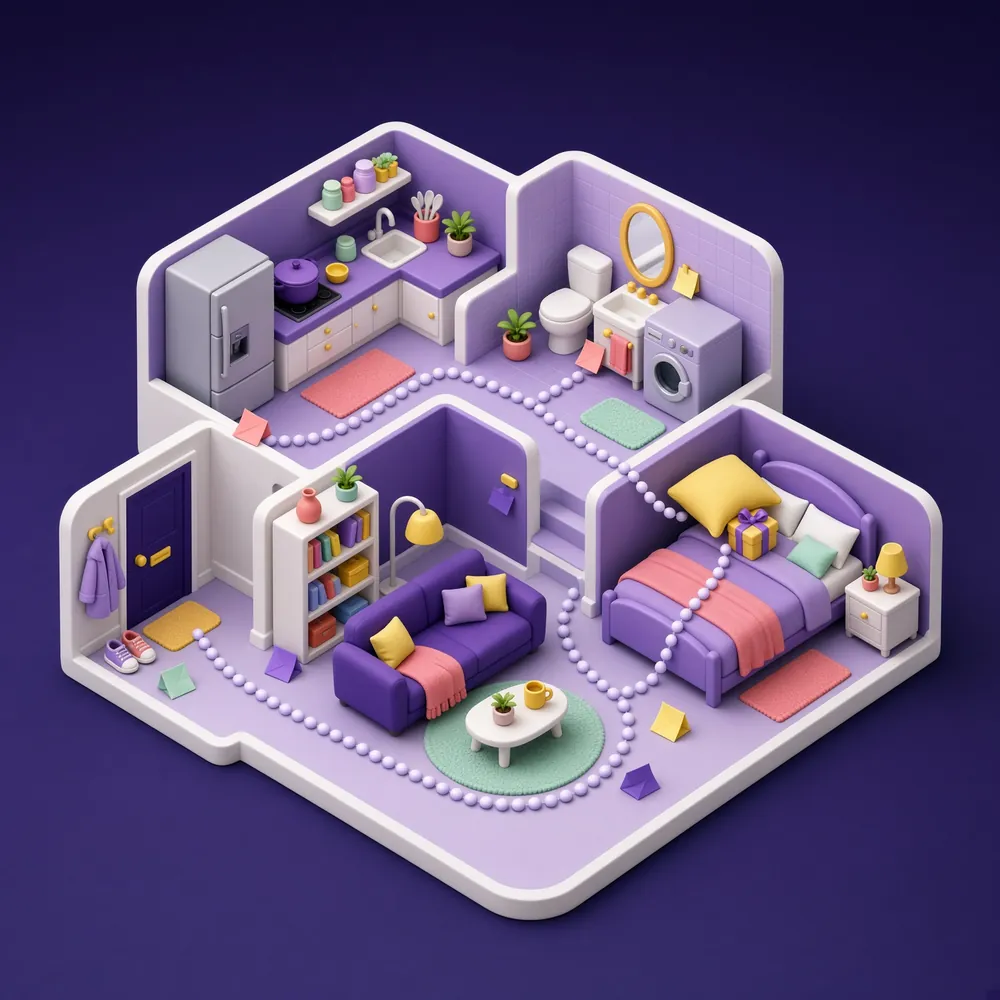
Birthday scavenger hunt clues
How it all works: three ready clue sets, hiding spots, tips and the hunt generator in the app.
Scavenger hunt for your girlfriend or wife
Three hunts from him: good morning with coffee, your places and a secret admirer.Built around one person
A hunt with their name, their jokes and your home in it
The hunt generator in GIFTbase
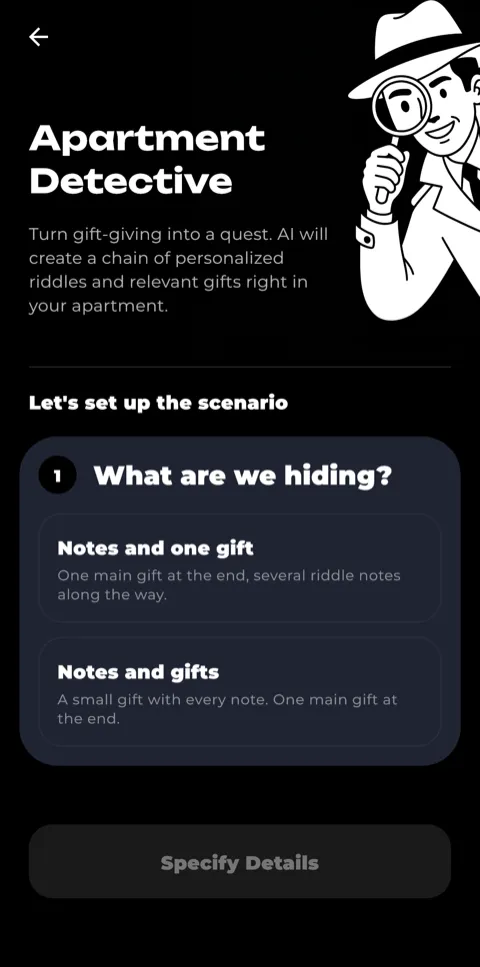
Ready-made clues are great because they fit any home. Their weakness is the same thing: your person is not in them. The generator in the app writes a story around a specific recipient — their name, age and hobbies — and around the hiding spots you actually have.
- Tick the hiding spots you have at home and pick the difficulty
- A story — detective, pirates or your own theme — with jokes about the birthday person
- A ready print sheet: clues, opening note, organizer’s key
- Two-week free trial

Frequently asked questions
Five to seven. Kids aged 4–6 are happy with four or five, tweens with six or seven, adults with up to nine. Count in time: one clue is two or three minutes of searching, so the whole hunt fits into 15–20 minutes — before it gets boring.
At home, almost. In a treasure hunt the clues lead to one prize at the end; in a classic scavenger hunt players collect a list of items. A clue trail around the house mixes the two: each clue points to the next hiding spot and the last one points to the gift, so every riddle on this page works for either.
From four, if an adult reads the clues and the spots are simple: the fridge, the toy box, under the pillow. From six or seven kids read on their own and the “Kids 7–10” clues fit. For a teenager use the adult level — direct hints will feel patronising.
A studio still has thirty hiding spots; they are just closer together. Take five clues and alternate heights: floor (doormat), table height (microwave), shelf (books), floor again (shoes). Even a short trail feels like a journey that way.
Agree on the rules before you start: one hint per clue, or “warmer / colder”. After two minutes of a dead end, give the hint yourself without waiting to be asked — the hunt is about the excitement and the gift at the end.
Some do: the balcony, the shoes, the jacket, the backpack. For the greenhouse, the swing or the shed, write your own with the “feature + misdirection + action” formula above — a clue takes about a minute. Outdoor hunts work better when every stop also has a small challenge.
A clue leads to the next place; a challenge tests something: a puzzle, a cipher, “find five red things”. A good home hunt alternates them: two or three clues in a row, then a challenge. Ciphers and a cipher tool are on the hunt-for-adults page.
No. The PDF with all 90 clues and the print sheet from the builder open straight away, no email and no subscription. The only condition: please do not republish the texts on other sites as your own.
Yes — in the GIFTbase app. The generator writes a story around the person’s name, age and hobbies and around the hiding spots you tick in your own home, and gives you a print sheet with clues and an answer key. Hunts are part of the GIFTbase subscription, which comes with a two-week free trial.
Updated September 26, 2026
Related gift guides

Gifts for Book Lovers: 10 Ideas Readers Actually Keep (2026)
The best gift for a reader is rarely a book. Ten things that make reading better, from a…

Gifts for Tech Nerds and PC Gamers: 11 Ideas
Eleven gifts for the person whose desk has more cables than furniture: setup upgrades…

Cozy Gifts for Homebodies: 18 Hygge Ideas
Eighteen gifts for the person whose ideal Friday is a blanket, a candle and nowhere to…
A gift for the final hiding spot
The hunt is ready — now put something worth finding in the last spot. GIFTbase picks gifts for one specific person: tell the app who they are and what they love, and get 10 ideas with real store links. Free to start.

